
Fatigue torsion tests determine a material’s resistance to repeated cycles of tangential stress, which is critical for components such as engine or drive shafts. An alternating or fluctuating torque is applied to measure the number of cycles before failure, yielding \(S-N\) (Wöhler) curves for fatigue life.
To analyze the material’s behavior under cyclic loads, defining the fatigue limit under torsional conditions.
Cyclic torque, often with a reversal of direction (alternating torsion).
Pure Torsion: Cyclic shear stresses only.
Axial/Combined Torsion: Torsional stresses combined with tension or compression.
Torque, twist angle, number of cycles to failure.
Creation of Wöhler (S-N) diagrams to evaluate the component’s service life.
These tests are crucial for simulating real operating conditions and ensuring that components do not fail under cyclic loads below the static breaking limit
Torsional fatigue tests evaluate the strength of materials and components (screws, shafts, couplings) subjected to repeated cycles of torsional loads, which are crucial for preventing sudden failures in the automotive, aerospace, and biomedical sectors. They measure parameters such as the shear modulus of elasticity and the fatigue limit.
Testing of components such as drive shafts, stabilizer bars, steering systems, and coil springs to ensure safety and durability under dynamic stress.
Testing of materials and structures subjected to repeated torsion during flight.
Evaluation of the torsional strength of medical devices, including bone screws and surgical drill bits.
Analysis of couplings, rotating shafts, and fasteners.
The test applies a cyclic torsional moment, often in combination with axial loads (biaxial testing), to simulate real-world conditions.
Number of cycles to failure, torsional moment amplitude, torsion angle, and structural failure.
To determine the material’s fatigue limit—that is, the stress value below which the material can withstand a theoretically infinite number of cycles.
The tests are conducted in accordance with international standards using servo-hydraulic or electric testing machines, often supplied by specialized companies.
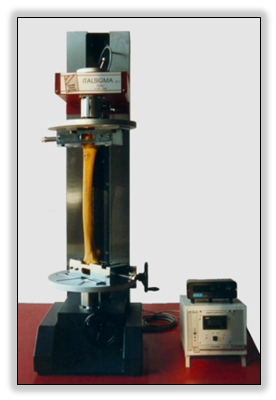
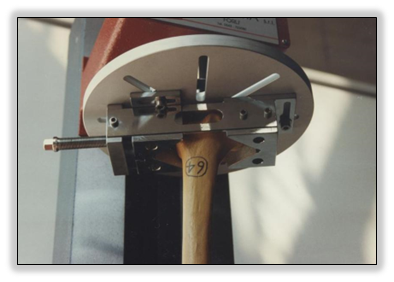
High-stiffness frame designed for torsion testing of femoral prostheses.
The torsional load is generated by an electronically controlled motor, with precise control of the angle of rotation. The lower test platform rotates and can apply a preload to the prosthesis.

Holding Company

Sister Company
©2026 ITALSIGMA S.r.l. Via Masetti, 50 – 47122 Forlì (FC) ITALY
P.IVA IT01763520408 | C.F. 01763520408 | Privacy&Cookie Policy | Credits: Wizard srl